Kaieteur Falls overland trek: the 4-5 day route via the Potaro River
The Kaieteur Falls overland trek takes you from Georgetown to the top of the falls by road, river boat and forest trail, usually over 4 to 5 days on the move. Here's the route stage by stage, how hard the final climb is and how you get home.

The Kaieteur Falls overland trek is the long way to Guyana's great waterfall: a road trip from Georgetown to the gold-mining town of Mahdia, boat rides up the Potaro River past Amatuk and Waratuk falls, a forest walk to Tukeit, and finally a steep climb of several hours to the top of Kaieteur. Most organised trips spend about 4 to 5 days travelling in, then fly back to Georgetown from the airstrip at the falls.
It is the opposite of the day trip. Instead of seeing the 226-metre drop an hour after take-off, you earn it, camp by the river, sleep in hammocks and reach the falls the way people did before there was an airstrip. Here is how the route works.
The Kaieteur Falls overland trek, stage by stage
Itineraries differ in the details, but the published routes follow the same line: Georgetown, Linden, Mahdia, Pamela Landing, Amatuk, Waratuk, Tukeit, Kaieteur. A typical version looks like this.
Day 1: Georgetown to Mahdia and the river. An early start, often around 6:30 am, for a road journey of about 8 hours into the interior. The road runs south past the bauxite town of Linden and on to Mahdia, a busy mining town in Region 8. From Pamela Landing on the Potaro, a boat takes you about two and a half hours upriver to Amatuk Falls, a drop of about 170 feet (about 50 metres). The first night is usually a riverside camp at Amatuk.
Day 2: Amatuk to Waratuk. A mix of walking and boating. Groups carry or walk around the rapids, cross creeks on tree-trunk bridges, stop to swim, and take short boat rides through calmer stretches of the gorge, whose forested walls rise hundreds of metres on either side. Camp at Waratuk Falls.
Day 3: Waratuk to Tukeit. Depending on the operator and the river, this is either a long hike through the forest (some itineraries plan the better part of a day on foot) or a shorter walk plus a boat ride. Tukeit sits near the foot of Kaieteur, and on a clear day you start to hear and glimpse what is coming. Night in hammocks at Tukeit.
Day 4: The climb to the top. The big one. The trail up to the plateau is known locally as the "Oh My God" mountain, and it earns the name: steep, rocky, with some scrambling over roots and boulders. Published times range from about 2 to 6 hours, with most accounts landing around 4 to 4.5 hours, depending on the weather, the wet ground and your fitness. You reach the top beside the falls and spend the night at the Kaieteur guest house.
Day 5: Kaieteur and the flight home. A guided walk to the lookouts, then a flight back to Georgetown from the Kaieteur airstrip. Some longer packages add a full extra day in the park before flying out, which turns the whole trip into about 7 or 8 days including arrival and departure in Georgetown.
To see what the route looks like, watch [Overland by road and river to Kaieteur, hiking bottom to top](/tv/watch/QjEGv4udrxk) by Outdoorlife Guyana, and [Overland tour to Kaieteur](/tv/watch/0XbirPvQt5I) by Gregory De Souza, both free on Kaieteur TV.
How hard is the overland trek?
Tour companies rate it anywhere from easy-to-moderate to demanding, and the honest answer is in between: you don't need climbing skills, but you do need to be comfortable walking for several hours a day in heat and humidity, on wet, uneven ground.
- The climb is the crux. Expect a steady, steep uphill of several hours. Good grip on your shoes matters more than anything else.
- The river sets the pace. Water levels change the boat legs and how much walking you do around rapids.
- It is basic. Nights are in hammocks or simple camps, with river washing and no phone signal for much of the route.
- Weight limits apply on the flight out. Domestic flights to and from the interior often limit baggage to about 20 lb (about 9 kg) per person, so pack light and ask your organiser.
If that sounds like too much, the day trip still gives you the full view of the falls. Our guide on [how to get to Kaieteur Falls](/stories/how-to-get-to-kaieteur-falls) compares the two.
When to go and how to book
Trips run through much of the year, but the dry spells are easier on the trail and the camps. Guyana's coast and north have two rainy seasons, roughly May to June and December to January, so trek organisers often point to February to March and August to November. Wet weather makes the climb slippery and the river higher; it also makes the falls themselves bigger, so there is a trade-off. Our [month-by-month guide to the best time to visit](/stories/best-time-to-visit-kaieteur-falls) has more detail.
The overland trek is always done with a guide and an organised group. Boats, camps, food and the return flight are arranged together, and the park fee for [Kaieteur National Park](/stories/kaieteur-national-park) is handled as part of the trip. Departures are less frequent than day trips and often need a minimum group size, so plan well ahead. When you compare trips, ask:
- How many days are spent travelling in, and how many at the falls?
- Is the Waratuk to Tukeit leg on foot, by boat or both?
- Is the return flight from Kaieteur included?
- What should you bring: hammock, sleeping bag, insect net?
- Are porters available for your bag on the climb?
Overland trek vs the day trip
| | Overland trek | Day trip by plane | |---|---|---| | Time | About 4-5 days travelling in, plus a day or two | One day, home by afternoon | | Effort | Long walks, a steep climb of several hours | A short, mostly easy trail | | Nights | Hammocks and river camps | None | | What you see | Amatuk, Waratuk, Tukeit, the gorge from below, then the falls | Kaieteur from the air and from the lookouts |
Many people do the day trip first and come back for the trek. If you want the big view without the camping, [see Kaieteur Falls by plane](/kaieteur-falls); seat availability changes daily.
Kaieteur Falls overland trek: FAQ
How many days is the Kaieteur overland trek? Usually about 4 to 5 days of travel from Georgetown to the top of the falls, with a flight back. Packages that include arrival, an extra day in the park and departure run about 7 to 8 days.
Can you walk to Kaieteur Falls from Georgetown? Not the whole way. The first stage is by road to Mahdia, then by boat on the Potaro River. The walking starts around Amatuk and ends with the climb from Tukeit to the plateau.
How long is the climb to the top of Kaieteur? Most accounts put it at about 4 to 4.5 hours, though published times range from about 2 to 6 hours depending on fitness and weather.
Do you have to fly back? Almost every organised trek ends with a flight from the Kaieteur airstrip to Georgetown, which saves you repeating the route in reverse.
Is the overland trek safe? It is done with local guides, who know the river and the trail. The main risks are slips on the climb and heat, so wear good shoes, drink plenty of water and listen to your guide.
Ready to see Kaieteur?
Whether you trek in or fly, the moment you reach the edge is the same. For the quickest way there, check day-trip seats on the [home page](/) or [request a date](/request), and watch more of the falls on [Kaieteur TV](/tv/watch/3dXhadpOEc0).
Planning a trip? Compare Kaieteur Falls tours and day trips: live seats and prices from every licensed operator.
Shared something we should credit differently, or want your video removed? Message us and we'll fix it the same day.
More Kaieteur stories

Kaieteur National Park: fees, rules, trails and what's inside
Kaieteur National Park is the protected area of about 627 km² around Kaieteur Falls, run by Guyana's Protected Areas Commission. Here's how fees work, the park rules, the trail to the lookouts and what lives inside.
Kaieteur Falls facts: 25 things most visitors don't know
The best Kaieteur Falls facts in one place. A 226 m single plunge, a frog that lives in one plant, a park older than almost any in the Amazon, and 22 more things most visitors never hear.
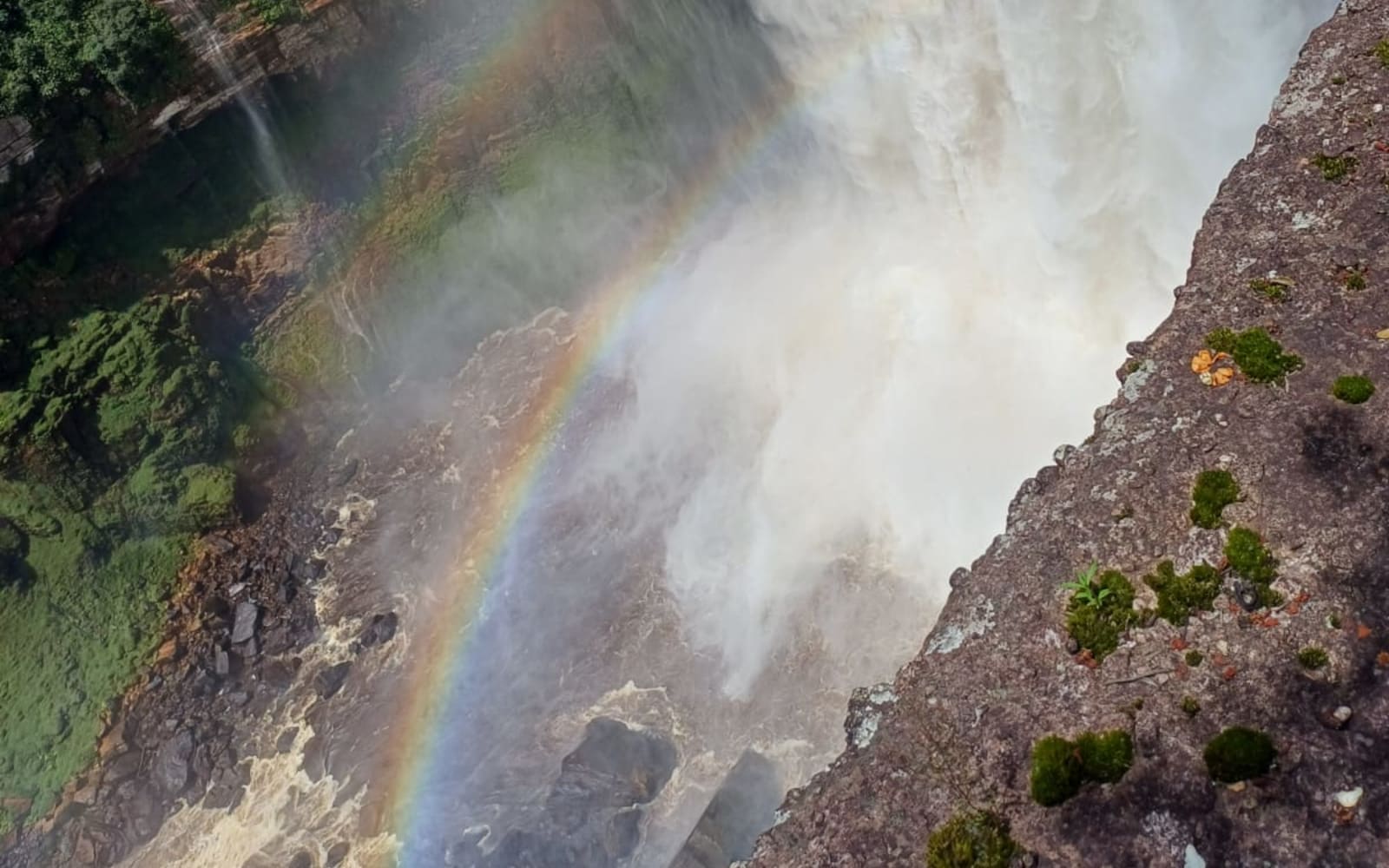
Best time to visit Kaieteur Falls: a month-by-month guide to rain, water and rainbows
The best time to visit Kaieteur Falls is the drier stretch from about February to April, or September to early November, when flights run more smoothly. Come just after the big rains for the most water. Here's how each month compares.